

To witness a loved one in the grip of addiction is to navigate a profoundly isolating and complex emotional landscape. The relentless cycle of anxiety, the breakdown in communication, and the feeling of utter helplessness can become an overwhelming burden, leaving you exhausted and uncertain of where to turn. It is a quiet crisis, one where your own well-being is often relegated to the background. Yet, it is precisely within this challenging space that a path toward restoration can begin—not only for them, but for you. In London, dedicated Family & Friends Support Programs offer a confidential sanctuary for this very purpose, providing the structure and empathy required to move forward.
This guide serves as your discreet and compassionate map through this territory. Here, we will explore the essential, evidence-based strategies for supporting your loved one effectively while, crucially, learning to establish the healthy boundaries necessary to protect your own mental and emotional health. Our purpose is to provide you with a clear, restorative path, helping you feel less alone and more in control of the situation as you navigate the journey ahead with renewed strength and understanding.
Key Takeaways
- Prioritising your own well-being is not selfish; it is a fundamental prerequisite for supporting your loved one effectively through their recovery journey.
- Discover how to navigate London’s complex landscape of Family & Friends Support Programs, from NHS services to discreet charitable organisations.
- Acquire practical communication strategies designed to reduce conflict and foster a more honest, constructive dialogue with your loved one.
- Understand why bespoke, individual therapy is a powerful tool for restoring your own balance and resilience, independent of your loved one’s treatment.
The Hidden Toll: Recognising Addiction’s Impact on You
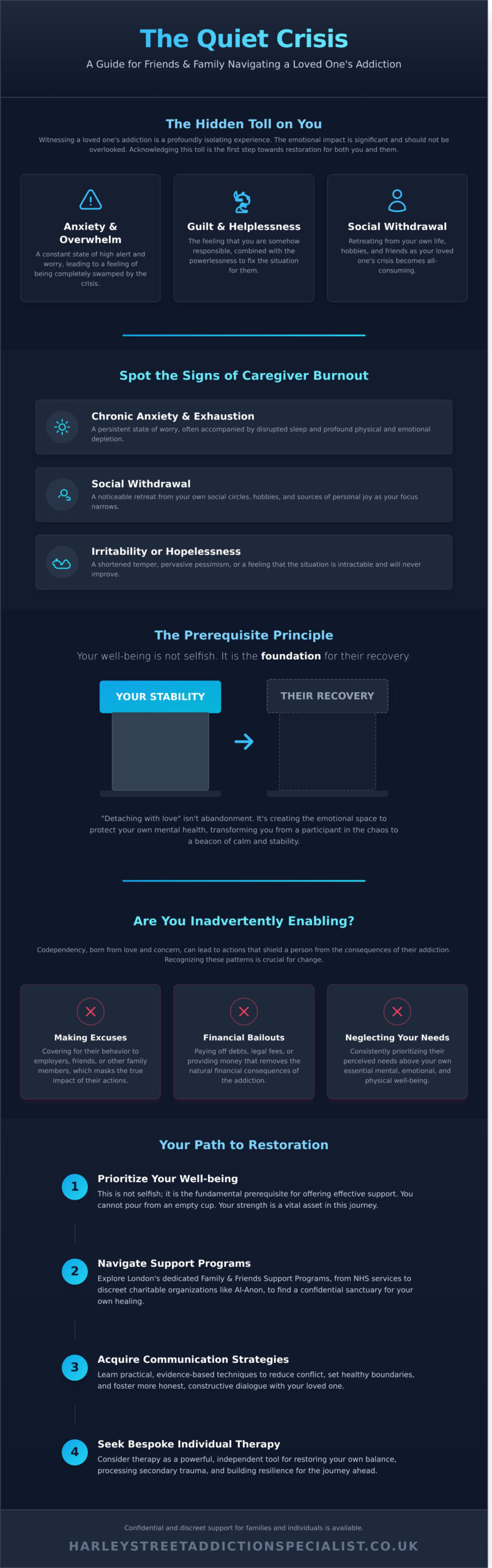
When a person you love is in the grip of addiction, your world invariably shrinks to the size of their crisis. It is a profoundly isolating experience, and the feelings that arise—overwhelm, anger, guilt, and sheer helplessness—are not only normal but are a testament to your deep connection. In the relentless, high-stress environment of a city like London, these pressures can become magnified, leaving you feeling adrift. Acknowledging the toll this journey takes on you is not a distraction from their recovery; it is an essential component of it.
This sustained state of high alert often leads to what clinicians identify as ‘compassion fatigue’ or ‘caregiver burnout’. These are not failures of character but are the predictable neurobiological and emotional consequences of prolonged exposure to stress and trauma. Understanding this is the foundational step toward seeking the restoration you deserve, which is precisely why dedicated Family & Friends Support Programs exist. They provide a sanctuary for your own healing.
Signs of Caregiver Burnout
Recognising the signs within yourself is the first, crucial step toward restoration. These symptoms often accumulate gradually, so it is essential to be vigilant for changes in your own well-being. Key indicators include:
- Chronic Anxiety and Exhaustion: A persistent state of worry, often accompanied by disrupted sleep patterns and a profound sense of physical and emotional depletion.
- Social Withdrawal: A noticeable retreat from your own social circles, hobbies, and sources of personal joy as your loved one’s needs become all-consuming.
- Increased Irritability or Hopelessness: A shortened temper, a pervasive sense of pessimism, or the feeling that the situation is intractable and will never improve.
Secondary Trauma and Its Effects
Witnessing the destructive cycle of a loved one’s addiction is, in itself, a traumatic experience. This is known as secondary trauma, and its effects are a legitimate health concern that must be addressed. It can manifest as a state of hyper-vigilance—constantly anticipating the next crisis—or as an emotional numbness, a protective mechanism to cope with overwhelming pain. It is imperative to understand that your psychological response is valid. Renowned peer-led initiatives like Al-Anon Family Groups were founded on this very principle: that the family’s experience requires its own distinct path to healing. Acknowledging this trauma is not self-indulgent; it is a clinical necessity for your own recovery.
Why Your Well-being is a Prerequisite for Their Recovery
When someone you love is struggling with addiction, your instinct is to pour every ounce of your energy into their survival. It is a common, and deeply human, response to believe that focusing on your own needs is selfish. However, this perspective is not only unsustainable; it is counterproductive to their long-term recovery. The truth is, your emotional and psychological stability is not a luxury—it is the very foundation upon which a healthier family dynamic can be rebuilt. The profound Impact of Substance Use Disorders on Families is well-documented, and restoring your own strength is the first, most critical step toward navigating this crisis effectively.
This process often involves a concept known as ‘detaching with love’. It is not about abandonment, but about creating the emotional space necessary to protect your own mental health while allowing your loved one to face the natural consequences of their actions. By creating a stable and predictable environment, you cease to be part of the chaos and instead become a beacon of calm—a safe harbour they may eventually choose to steer towards.
Understanding Codependency and Enabling
Codependency often develops subtly, born from a place of love and concern. It is a pattern where your sense of self becomes enmeshed with your loved one’s addiction, and you find yourself reacting to their behaviour rather than living your own life. This frequently leads to enabling—actions that inadvertently shield the individual from the consequences of their addiction. Common examples include:
- Making excuses for their behaviour to employers or other family members.
- Providing financial bailouts for debts or legal issues.
- Prioritising their perceived needs above your own essential well-being.
Professional guidance within bespoke Family & Friends Support Programs is essential for helping you recognise these intricate patterns and begin the transformative work of changing them.
The Power of Setting Healthy Boundaries
Establishing boundaries is an act of profound self-respect, not a form of punishment. A boundary communicates what you will and will not accept, thereby protecting your emotional, financial, and physical health. These are not ultimatums designed to control your loved one, but clear, calm statements of your own limits. Practical examples might include refusing to provide money, declining to answer late-night calls when they are intoxicated, or insisting they do not use substances in your home. Because maintaining these boundaries in the face of emotional pressure is immensely challenging, professional support is often the key to establishing them with conviction and consistency.
Navigating Support Options for Families in London
When a loved one is struggling with addiction, the landscape of support in a city as vast as London can feel overwhelming. Understanding the distinct pathways available is the first step towards finding the solace and strategic guidance your family needs. The capital offers a spectrum of Family & Friends Support Programs, primarily across three sectors: the NHS, charitable organisations, and private specialists. Each provides a different level of care, and the right choice depends entirely on your unique circumstances, need for discretion, and the urgency of your situation.
| Factor | NHS Services | Charitable Groups | Private Therapy |
|---|---|---|---|
| Cost | Free at the point of use | Free (donation-based) | Fee-based (£££) |
| Waiting Times | Can be significant (weeks to months) | Variable, drop-in or short wait | Immediate access |
| Confidentiality | High, within the NHS system | Shared within a group setting | Absolute and legally protected |
| Specialisation | Often generalist; may refer on | Peer-led; focused on shared experience | Bespoke, expert-led, and highly specialised |
NHS and Charitable Support
For many, the first port of call is the NHS or one of the UK’s outstanding charities like Adfam or Al-Anon. These services provide an invaluable lifeline, offering structured group sessions where shared experience fosters a powerful sense of community and reduces isolation. The primary benefit is that they are free and accessible. However, it is important to be aware of their potential limitations, which can include long waiting lists and a less individualised approach that may not address the complex trauma you have personally experienced.
Private Therapy: A Bespoke Approach
For those requiring immediate, discreet, and highly tailored support, private therapy offers a sanctuary for healing. The core advantage lies in one-to-one, confidential sessions that are built entirely around your needs and schedule. This bespoke environment allows for the use of advanced, evidence-based techniques such as EMDR or hypnotherapy to process your own trauma and anxiety. For professionals, executives, and high-profile individuals, the absolute discretion afforded by a Harley Street specialist is not a luxury but a necessity. It ensures your family’s situation is managed with the clinical excellence and privacy it deserves. Explore a confidential consultation to discuss your unique situation.
Practical Strategies for Communication and Self-Preservation
Navigating a loved one’s addiction requires a delicate balance of compassionate support and resolute self-preservation. The emotional strain can be immense, yet it is within this challenging dynamic that you must find a way to communicate effectively while safeguarding your own mental and emotional wellbeing. These strategies are not merely suggestions; they are essential, evidence-based tools for restoring calm and fostering an environment where recovery can begin.
Effective Communication Techniques
Your words hold immense power. Learning to communicate in a way that de-escalates conflict and invites honesty is a cornerstone of effective support. Many of these skills are cultivated within professional Family & Friends Support Programs, but you can begin implementing these principles immediately.
- Use ‘I’ Statements: Rather than using accusatory ‘you’ statements, which provoke defensiveness, frame concerns from your own perspective. For example, “I feel anxious when I don’t hear from you, as I worry about your safety.” This conveys your feelings without assigning blame.
- Practise Active Listening: Listen to understand, not simply to respond. Validate their feelings—even if you cannot condone their actions. A simple acknowledgment like, “It sounds as though you are feeling immense pressure right now,” can create a crucial space for connection and reduce hostility.
- Know When to Disengage: Recognise when a conversation is no longer productive. If discussions become circular or hostile, it is not a failure to step away. State calmly that you need to pause the conversation and will resume when you are both more composed. This protects both you and the potential for future, constructive dialogue.
Building Your Personal Resilience
Your own wellbeing is not an indulgence; it is the foundation from which you can offer sustainable support. Neglecting your own needs will invariably lead to burnout and resentment, rendering you unable to help anyone effectively.
- Maintain Your Sanctuary: Do not allow the chaos of addiction to dismantle your own life. Continue with your work, your social engagements, and your daily routines. These structures provide an essential sense of normalcy and stability in turbulent times.
- Employ Grounding Techniques: In moments of acute stress, simple grounding techniques can be profoundly effective. Take a moment to consciously notice five things you can see, four you can touch, and three you can hear. This sensory exercise pulls your focus back to the present moment, interrupting the cycle of anxiety.
- Reconnect with Your Interests: Actively re-engage with hobbies and passions that define you outside of this crisis. Whether it is walking in one of London’s Royal Parks or visiting a gallery, these activities are vital for replenishing your emotional reserves.
While these personal strategies are powerful, navigating this journey alone can be exceptionally challenging. For a more tailored approach, our discreet, bespoke consultations in Harley Street are designed to equip you with the specific tools your family needs to heal.
How Bespoke Therapy on Harley Street Can Restore Your Balance
While group-based Family & Friends Support Programs provide invaluable community and shared understanding, there often comes a point where a more individualised and discreet approach is required. Navigating the profound emotional and psychological impact of a loved one’s addiction necessitates a level of care that is tailored exclusively to your unique circumstances. Individual therapy is not a lesser alternative; it is a dedicated space for you to process, heal, and rebuild your own sense of equilibrium, entirely separate from your loved one’s journey.
This is where bespoke, one-to-one therapy provides a level of depth and privacy that group settings cannot. It offers a confidential environment to dismantle complex feelings and develop sophisticated coping strategies that empower you to protect your own well-being.
A Therapeutic Sanctuary for You
In the absolute discretion of a Harley Street practice, you are given the sanctuary needed to explore your own authentic emotional responses. Here, feelings of grief, anger, frustration, and fear are not just permitted; they are understood as valid reactions to a traumatic situation. Working with a specialist allows you to address the often-overlooked consequences of supporting someone with an addiction, such as:
- Healing from secondary trauma and the chronic stress that leads to emotional and physical burnout.
- Developing robust boundaries that protect your mental health without resorting to ultimatums or detachment.
- Creating a clear, long-term strategy for your own life and happiness, independent of your loved one’s choices and recovery progress.
Your Path Forward with Stuart Downing
Stuart Downing specialises in the intricate and often painful dynamics that addiction creates within family systems. He moves beyond generic advice, employing evidence-based therapeutic methods to help you understand the roles you may have adopted and how to forge a healthier path forward. This process is collaborative and deeply respectful, designed to restore your agency and inner peace.
Taking the first step is a quiet act of courage and self-preservation. If you are ready to move beyond the generalised support found in many Family & Friends Support Programs and invest in your own dedicated recovery, we invite you to begin a conversation. Book a confidential assessment to begin creating your personal recovery plan.
Restoring Balance: A Way Forward for You and Your Family
Navigating the complexities of a loved one’s addiction is a profound challenge, one that invariably takes a toll on your own emotional and mental well-being. This guide has illuminated a critical truth: prioritising your own health is not a selfish act, but a fundamental prerequisite for creating a stable environment conducive to recovery. Recognising the need for your own support is the first, most powerful step you can take towards healing the entire family system.
While many resources are available, the most transformative Family & Friends Support Programs are those that offer truly personalised care. At our discreet Harley Street, London location, we provide a sanctuary for this essential work. With deep expertise in the complex family dynamics of addiction, we create bespoke therapy plans tailored to restore your individual balance, helping you to communicate effectively and preserve your own strength.
Taking that first step can feel daunting, but you do not have to face this alone. We invite you to contact us for a confidential discussion about your situation. Let us help you find your footing again, so you can become a calm and effective presence for both yourself and your loved one.
Frequently Asked Questions
Can I force my loved one to get help for their addiction?
In the United Kingdom, it is not legally possible to compel an adult into treatment against their will, unless they meet the strict criteria for being sectioned under the Mental Health Act. True, lasting recovery is rooted in personal choice. Your role, therefore, is not to force this decision but to create an environment that encourages it. A professionally guided family intervention can be a powerful, structured way to express your concerns and present the option of treatment with compassion and clarity.
How do I set boundaries without making my loved one feel abandoned?
Establishing boundaries is an act of profound care for both yourself and your loved one; it is about protecting your well-being and ceasing to enable the addiction. Communicate these boundaries clearly and calmly, framing them with love. For instance, you might state, “I love you deeply, but for my own health, I can no longer provide you with money or make excuses for your behaviour.” This redefines the relationship in a healthier, more sustainable way, which is a cornerstone of recovery.
Is what I’m experiencing codependency, and can therapy help with it?
Codependency often manifests as a pattern where your sense of worth becomes entwined with solving your loved one’s problems, frequently at your own expense. If you find yourself sacrificing your needs to manage their addiction, you may be experiencing this dynamic. Therapy is an exceptionally effective tool for addressing these patterns. A bespoke therapeutic plan can help you reclaim your sense of self, establish healthy relational boundaries, and build the resilience required to support your loved one without losing yourself.
How much does private therapy for family members cost in London?
The cost of private therapy in London for family members varies based on the clinician’s expertise and location. You can typically expect to invest between £100 and £300 per session for a highly qualified specialist, particularly in a prestigious area such as Harley Street. While this represents a significant commitment, it is a crucial investment in your own mental health and the long-term restorative health of your family unit. Many find this dedicated, expert support to be truly transformative.
What is the difference between a support group and individual therapy for me?
Support groups, such as Al-Anon or Families Anonymous, provide an invaluable sense of community and shared experience, allowing you to feel understood by others facing similar challenges. In contrast, individual therapy offers a confidential, one-to-one sanctuary with a clinical expert. Here, you receive a bespoke treatment plan tailored to your unique circumstances. Many individuals find that a combination of individual therapy and community-based Family & Friends Support Programs offers the most comprehensive path to healing.
How can I help if my loved one is in denial about their addiction?
Confronting denial directly often reinforces it. A more effective strategy is to express your concerns calmly, focusing on specific, observable behaviours rather than labels. Use “I” statements, such as, “I feel worried when I see this behaviour,” to convey your feelings without accusation. It is paramount that you seek your own support during this time. Engaging with professional Family & Friends Support Programs can equip you with the strategies to manage this challenging dynamic and protect your own well-being.
What support is available for children who have a parent with an addiction?
It is vital to create a safe and stable environment for children affected by parental addiction. In the UK, organisations like The National Association for Children of Alcoholics (Nacoa) offer a confidential helpline and excellent resources. Additionally, support may be found through school counsellors or dedicated child therapists who specialise in family trauma. These services provide a secure space for children to process their complex feelings and develop healthy coping mechanisms, shielding them from long-term emotional impact.
Recent Comments