

Living in the shadow of another’s volatility can be a profoundly isolating experience, leaving you emotionally exhausted and perpetually questioning your own perceptions. This sense of disorientation is often a hallmark of relationships impacted by narcissistic personality disorder, a complex condition that can erode one’s self-worth and mental equilibrium. If you feel as though you are navigating this challenging landscape alone, please know that your feelings are valid, and understanding the clinical nature of your situation is the first, crucial step toward reclaiming your sense of self.
This comprehensive guide has been created to provide you with that essential clarity. Here, within a framework of complete discretion, we will explore the defining traits of NPD, offer evidence-based strategies for setting protective boundaries, and illuminate a clear, bespoke path toward specialist support and lasting recovery here in London. A more peaceful future is not only possible; it is within your reach.
Key Takeaways
- Recognise the core clinical traits of NPD and understand how London’s high-stakes professional environment can uniquely amplify these behaviours.
- Understand the profound connection between sustained narcissistic abuse and the development of Complex PTSD (C-PTSD), validating the deep psychological impact you may be experiencing.
- Discover a practical toolkit for establishing firm, non-negotiable boundaries, a crucial first step toward reclaiming your personal autonomy and well-being.
- Explore why specialist therapy is essential for recovery from the effects of narcissistic personality disorder and how advanced treatments in London can address the underlying trauma.
Understanding Narcissistic Personality Disorder (NPD): The Core Clinical Traits
It is essential to approach the topic of narcissism with clinical precision and human compassion. Far more than a simple personality flaw or excessive vanity, Narcissistic Personality Disorder is a formal and complex mental health condition recognised in the Diagnostic and Statistical Manual of Mental Disorders (DSM-5). It is characterised by a pervasive and enduring pattern of grandiosity, a profound need for admiration from others, and a marked lack of empathy. Understanding these core traits is the first, crucial step toward recognising the condition, whether in oneself or in a loved one. A formal diagnosis must always be made by a qualified mental health professional, as it requires observing these patterns across various personal and social contexts.
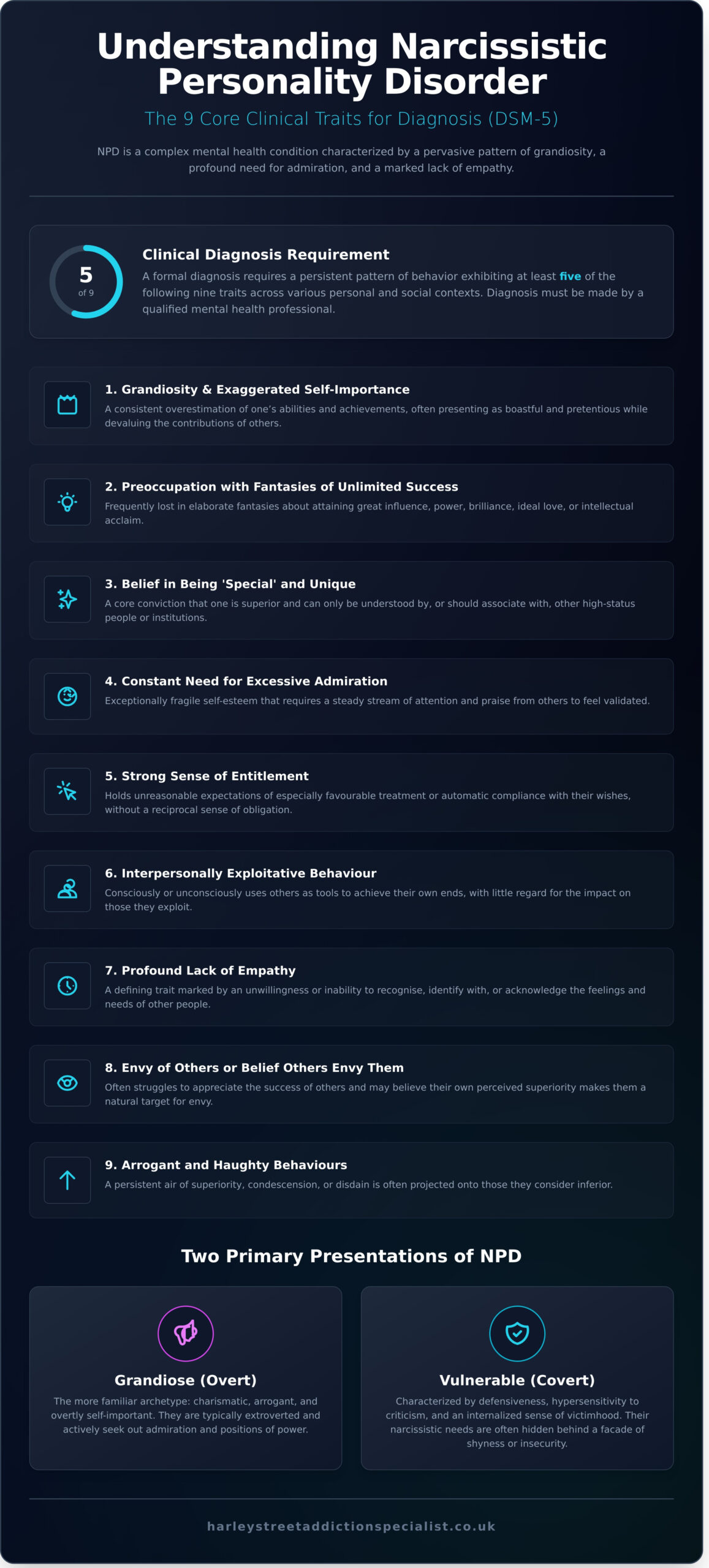
Clinically, an individual must exhibit at least five of the following nine criteria for a diagnosis of narcissistic personality disorder. These traits manifest in distinct thoughts and behaviours that significantly impair relationships and personal functioning.
The Nine Recognisable Signs of NPD
- Grandiosity and an exaggerated sense of self-importance: This involves a consistent overestimation of one’s abilities and achievements, often presenting as boastful and pretentious while devaluing the contributions of others.
- Preoccupation with fantasies of unlimited success, power, or brilliance: The individual is frequently lost in elaborate fantasies about attaining great influence, ideal love, or intellectual acclaim.
- A belief in being ‘special’ and unique: This is a core conviction that one is superior and can only be understood by, or should associate with, other high-status people or institutions.
- A constant need for excessive admiration: Their self-esteem is exceptionally fragile, requiring a steady stream of attention and praise from others to feel validated.
- A strong sense of entitlement: They hold unreasonable expectations of especially favourable treatment or automatic compliance with their wishes, often without a reciprocal sense of obligation.
- Interpersonally exploitative behaviour: The individual may consciously or unconsciously use others as tools to achieve their own ends, with little regard for the impact on those they exploit.
- A profound lack of empathy: This is a defining trait, marked by an unwillingness or inability to recognise, identify with, or acknowledge the feelings and needs of other people.
- Envy of others or a belief that others are envious of them: They often struggle to appreciate the success of others and may believe their own perceived superiority makes them a natural target for envy.
- Arrogant and haughty behaviours or attitudes: A persistent air of superiority, condescension, or disdain is often projected onto those they consider inferior.
It is also vital to recognise that NPD can present in two primary ways. Grandiose (‘overt’) narcissism is the more familiar archetype-charismatic, arrogant, and overtly self-important. In contrast, vulnerable (‘covert’) narcissism is characterised by defensiveness, hypersensitivity to criticism, and an internalised sense of victimhood, though it stems from the same core feelings of entitlement and self-absorption. Recognising this distinction is key to a deeper, more nuanced understanding of the disorder.
The London Narcissist: How NPD Manifests in a High-Stakes Environment
London’s relentless pace and competitive ethos create a unique ecosystem where ambition is celebrated. However, this high-stakes environment can also amplify the traits associated with narcissistic personality disorder. The city’s vastness and inherent anonymity provide a stage where manipulative behaviours can be deployed with fewer immediate social consequences, making it crucial to understand how these patterns manifest in both professional and personal spheres. The constant pressure to project an image of success and invulnerability can become a fertile ground for narcissistic dynamics to take root and flourish.
Corporate & Professional Settings
In the City and other elite professional circles, a colleague or manager with narcissistic traits may leverage their career status as a primary source of validation. While initially appearing charismatic and confident, their underlying patterns can become profoundly damaging to a team’s morale and productivity. Identifying these behaviours requires a nuanced understanding of the core symptoms and causes of NPD, as they are often masked by a veneer of professional ambition. Key indicators include:
- Consistently taking credit for the work of others to advance their own position.
- A profound refusal to accept accountability for failures, instead shifting blame onto colleagues or external factors.
- The strategic use of charm and professional networks not for mutual benefit, but to manipulate and gain an advantage.
Social Circles & Personal Relationships
London’s dynamic social scene, with its emphasis on status and appearance, can be a challenging landscape. Here, the pressure to maintain a perfect public image is immense. In personal relationships, tactics such as ‘love bombing’-overwhelming a new partner with intense displays of affection-can feel exhilarating in a fast-paced city. However, this is often a precursor to control, followed by insidious techniques like gaslighting, where your reality is persistently undermined. This leaves you feeling isolated and confused, even in a city of millions, as the narcissist works to maintain absolute control over the relationship.
The Hidden Toll: Narcissistic Abuse, Trauma, and Addiction
The experience of being in a relationship with an individual exhibiting traits of narcissistic personality disorder is not merely difficult; it is a form of profound psychological and emotional trauma. Narcissistic abuse is insidious, eroding your sense of self over time, leaving you in a state of confusion, chronic self-doubt, and deep exhaustion. If these feelings resonate, please know they are a valid and understandable response to an incredibly damaging dynamic. You are not imagining the pain, and you are not alone in your search for clarity.
Recognising the Cycle of Narcissistic Abuse
This form of abuse typically unfolds in a predictable, destabilising pattern. It begins with a phase of intense idealisation, where you are placed on a pedestal, only to be followed by a period of systematic devaluation, where you are criticised, belittled, and controlled. This often culminates in a sudden and callous discard. Central to this cycle are manipulative tactics such as gaslighting (making you question your own sanity) and projection (attributing their own negative behaviours to you). These behaviours are often a direct manifestation of the core traits detailed by the Mayo Clinic on NPD symptoms, and their primary function is to dismantle your self-esteem and your ability to trust your own judgment.
From Trauma to Addiction: The Search for Relief
Living in a state of constant emotional threat places the nervous system on high alert, creating a chronic stress response. This sustained neurobiological strain is the fertile ground for Complex PTSD (C-PTSD). To cope with the relentless anxiety and emotional pain, it is not uncommon for individuals to seek solace in external sources. You may turn to alcohol to quiet the inner critic, or substances like cocaine to temporarily escape the feelings of worthlessness. This is not a moral failing; it is a desperate attempt to self-medicate an unbearable wound. At our Harley Street clinic, we understand that for recovery to be lasting, we must provide bespoke treatment that addresses both the addiction and its traumatic roots simultaneously.
A Practical Toolkit for Healing: Setting Boundaries & Reclaiming Your Life
Navigating a relationship with an individual exhibiting the traits of narcissistic personality disorder requires not just emotional resilience but a strategic, protective toolkit. The path to healing is an active process of reclaiming your personal sovereignty. This involves implementing clear, actionable steps designed to protect your mental well-being and begin a transformative journey back to your authentic self. Your recovery is not a passive event; it is a conscious act of self-preservation and restoration.
Step 1: Establishing and Enforcing Boundaries
Boundaries are not an attempt to change the other person; they are a non-negotiable declaration of how you expect to be treated. It is essential to communicate your limits calmly and factually, avoiding emotional language that can fuel conflict. For instance, state clearly, “I will not continue this conversation while being disrespected.” The consequence must be immediate and consistent: you disengage from the interaction. To de-escalate and reduce opportunities for manipulation, consider these techniques:
- The Grey Rock Method: Making your responses and reactions as brief and uninteresting as a grey rock, thereby denying the individual the emotional reaction they seek.
- Information Dieting: Carefully limiting the personal details you share to prevent them from being used against you in the future.
Learning to say ‘no’ without guilt is a cornerstone of this process, allowing you to prioritise your own well-being, often for the very first time.
Step 2: Rebuilding Your Sense of Self
Prolonged exposure to the dynamics of a narcissistic relationship can significantly erode your identity, leaving you feeling disconnected from your own values and desires. The recovery process involves a conscious rediscovery of who you are outside of this dynamic. Re-engage with hobbies, friendships, and passions that bring you genuine joy and a sense of accomplishment. Building a robust support network-whether trusted friends in London or family further afield-is paramount; these are the people who will validate your reality and reflect your true worth back to you. Practices such as mindfulness and dedicated self-compassion are not indulgences but essential clinical tools for healing the deep wounds of emotional abuse.
These foundational steps are pivotal in reclaiming your life. This journey requires immense courage, and professional guidance can provide a safe sanctuary for healing. For a discreet consultation and a bespoke therapeutic plan, we invite you to contact our Harley Street clinic.
Seeking Specialist NPD Therapy in London: Your Path to Recovery
Navigating the aftermath of a relationship shaped by narcissistic abuse requires more than conventional counselling; it demands a specialised, nuanced approach. Standard therapeutic models may fail to address the specific psychological manipulation and deep-seated trauma that often result from these dynamics. True recovery necessitates a practitioner who understands the intricate patterns of narcissistic personality disorder and can guide you through a healing process that is both validating and transformative.
The emotional and psychological wounds inflicted by such experiences often manifest as a form of complex trauma. To this end, advanced, evidence-based therapies such as Eye Movement Desensitisation and Reprocessing (EMDR) and clinical hypnotherapy are instrumental. These powerful modalities work directly with the subconscious and the nervous system to process distressing memories and dismantle the negative core beliefs left in the wake of emotional abuse, offering a depth of healing that talk therapy alone cannot always reach.
Why Choose a Specialist on Harley Street?
Choosing a specialist in London’s revered medical district means entrusting your care to an expert with a profound understanding of personality disorders and their frequent interplay with addictive behaviours. Here, absolute discretion is not a luxury but a fundamental guarantee. Your journey is underpinned by a completely bespoke treatment plan, utilising advanced therapeutic modalities that extend beyond the scope of what is often available through standard NHS provisions, ensuring your unique needs are met with clinical excellence.
Your First Step Towards a Bespoke Recovery Plan
Taking the first step is often the most courageous part of the journey. Your initial consultation is designed to be a sanctuary-a confidential space where your experiences are heard, validated, and understood without judgment. It marks the beginning of a collaborative process, where a clear path toward profound and lasting recovery is carefully mapped out with you. Healing is entirely possible when you are guided by dedicated, specialist support. We invite you to book a confidential consultation to begin your recovery journey.
Your Bespoke Path to Recovery in the Heart of London
Navigating the aftermath of a relationship shaped by narcissistic abuse requires both profound understanding and courageous action. As we have explored, recognising the clinical traits and the hidden toll of narcissistic personality disorder is the foundational step toward healing. Yet, true recovery is an active process of reclaiming your autonomy, setting firm boundaries, and rebuilding your sense of self with expert guidance. This journey, while challenging, is entirely possible.
When you are ready to take that decisive step, specialist support is paramount. Led by the renowned Stuart Downing from our discreet and confidential Harley Street location, we offer a sanctuary for profound healing. Our bespoke therapy plans, integrating powerful modalities like hypnotherapy and EMDR, are designed to address the unique complexities of your experience. Book a confidential consultation on Harley Street to begin your bespoke recovery journey. A future defined by peace and self-possession awaits.
Frequently Asked Questions
Can a person with narcissistic personality disorder change?
Change is profoundly challenging for an individual with narcissistic personality disorder, as the condition is characterised by a lack of self-awareness and an unwillingness to admit fault. However, it is not entirely impossible. Meaningful, long-term change requires the individual’s dedicated commitment to specialised psychotherapy, such as psychodynamic therapy. While a complete transformation is rare, with expert clinical guidance, it is possible for some to learn to manage their behaviours and develop a greater capacity for empathy over time.
What is the difference between narcissism and narcissistic personality disorder (NPD)?
It is crucial to distinguish between narcissistic traits and the clinical diagnosis of Narcissistic Personality Disorder (NPD). Many individuals may display narcissistic traits, such as self-centredness or a degree of vanity, on a spectrum. NPD, however, is a pervasive and inflexible mental health condition defined by a persistent pattern of grandiosity, an intense need for admiration, and a profound lack of empathy. This pattern severely impairs an individual’s relationships and functional life, constituting a formal psychiatric diagnosis.
What is ‘gaslighting’ and how can I spot it?
Gaslighting is a sophisticated and insidious form of psychological manipulation intended to make you question your own sanity, memory, or perception of reality. You can spot it when someone consistently denies events you know happened (“I never said that”), questions your emotional stability (“You’re just being hysterical”), or systematically challenges your memories. The ultimate aim is to erode your confidence and increase your dependence on the manipulator, making it vital to recognise these invalidating tactics as a form of abuse.
Is it my fault if I am in a relationship with a narcissist?
It is unequivocally not your fault. Individuals with narcissistic traits are often exceptionally charming and charismatic, particularly in the initial stages of a relationship. They are adept at identifying and targeting empathetic, compassionate people. The responsibility for manipulative and abusive behaviour rests solely with the perpetrator. Your experience is not a reflection of a personal failing, but rather a testament to the complex and deceptive nature of narcissistic abuse. The first step towards healing is releasing this misplaced blame.
What kind of therapy is most effective for victims of narcissistic abuse?
For those recovering from narcissistic abuse, therapy must focus on rebuilding a sense of self and processing trauma. Evidence-based modalities such as Trauma-Focused Cognitive Behavioural Therapy (TF-CBT) are highly effective for addressing distorted thought patterns. Additionally, psychodynamic psychotherapy can help you understand the relational dynamics at play, while EMDR (Eye Movement Desensitization and Reprocessing) can be transformative for processing specific traumatic memories. A bespoke therapeutic plan is essential for a restorative journey.
How can I support a friend or family member dealing with a narcissist?
The most powerful support you can offer is to listen without judgment and consistently validate their reality. Avoid directly criticising their partner, which can trigger defensiveness; instead, focus on how the situation is making your loved one feel. Encourage them to seek professional, discreet support from a specialist who understands the nuances of narcissistic dynamics. Offering practical assistance, such as helping them research therapists in London or simply providing a safe space, can be immensely valuable.
Can you have a healthy relationship with someone who has NPD?
Forging a genuinely healthy, reciprocal, and emotionally safe relationship with an individual diagnosed with NPD is exceptionally difficult. The core characteristics of the disorder-including a fundamental lack of empathy, a need for control, and exploitative tendencies-directly undermine the trust and mutual respect required for a healthy partnership. If the individual is in long-term, intensive therapy and shows true accountability, a managed relationship with firm boundaries may be possible, but this is unfortunately the exception rather than the rule.
Are there support groups in London for victims of narcissistic abuse?
Yes, London offers a number of excellent support networks for those who have experienced narcissistic abuse. These groups provide a crucial sense of community and validation, helping to counteract the isolation that often accompanies this experience. You can find both peer-led and professionally-facilitated groups through national charities like Mind, online platforms, or via a referral from your GP or a private specialist. Engaging with a community of survivors is a powerful step in the healing process.
Recent Comments